
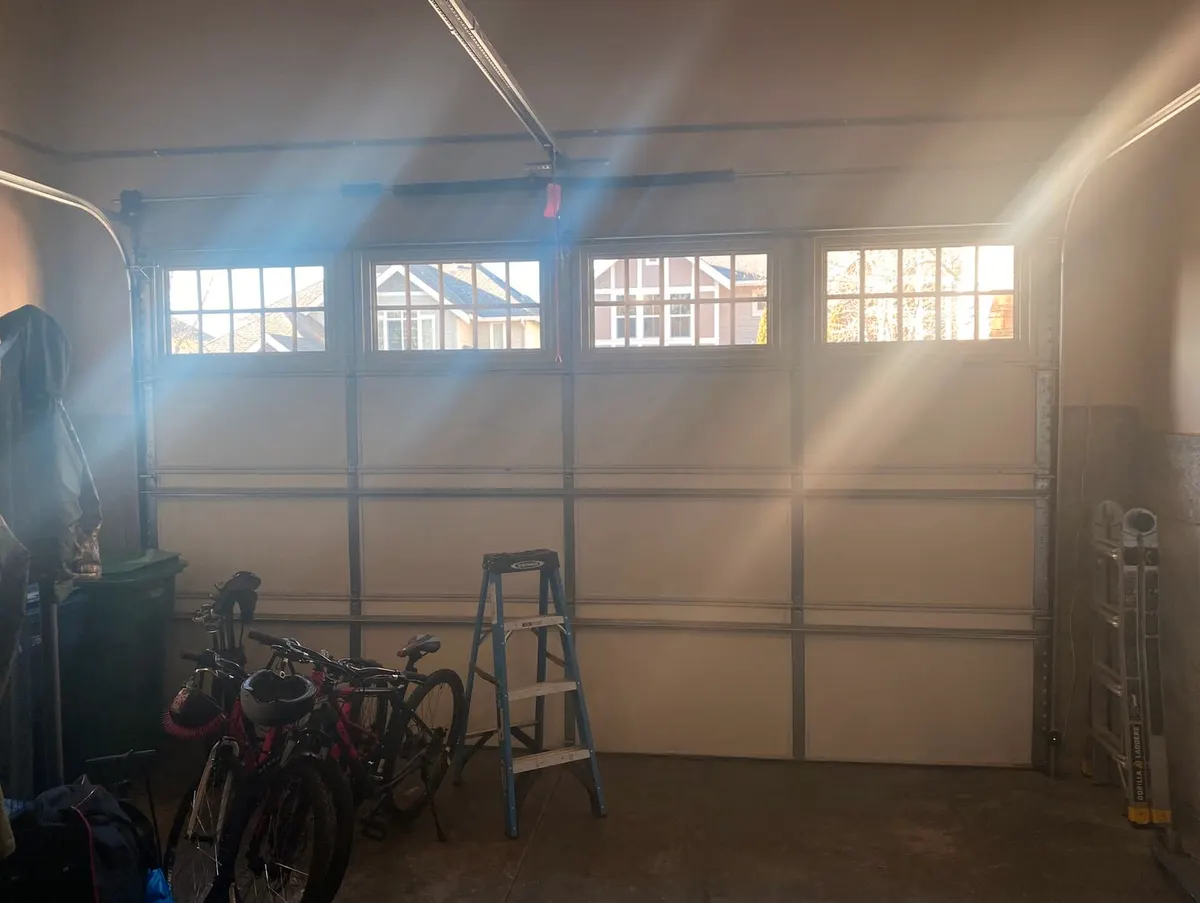
What a Technician Sees on These Calls
The call usually starts the same way: "My garage door just won't open" or "something exploded in my garage." The homeowner heard a loud bang, sometimes overnight, sometimes while the door was mid-cycle. By the time a technician gets there, the spring is already split in two, the door is dead weight, and the opener motor may have burned out trying to lift a door it was never built to lift alone.
What's frustrating is that almost every one of these springs was telling on itself for weeks, sometimes months, before it let go. Cold snaps and road salt are hard on torsion and extension springs in this part of Wisconsin, and a spring that's already fatigued from summer humidity and a decade of cycles often gives out right when temperatures drop and the metal gets brittle. The signs are there if you know where to look. Walk through this checklist in your own garage before winter settles in for good.
The Walkthrough
1. A visible gap between the coils
With the door fully closed, look at the torsion spring above the door (or the extension springs along the upper tracks if your garage has those). Healthy coils sit tight against each other. If you see a noticeable gap or a section where the coil looks stretched out compared to the rest, that spring has lost tension and is wearing unevenly. It's a strong sign it won't make it through another season of hard use.
2. Rust or pitting on the coils
Surface dust is normal. Actual rust, flaking, or pitted texture on the metal is not. Rust eats into the steel and creates weak points where the coil is more likely to crack under tension. Road salt tracked in on tires and boots, combined with humid summers, speeds this up more here than in drier climates.
3. A reddish-brown powder near the spring
This is the shed of rust and metal fatigue, and it collects on the floor or shelf below the spring. If you're sweeping up colored dust that wasn't there last time you looked, the spring is actively deteriorating.
4. The door looks crooked when it moves
Watch the door travel through a full cycle. If one side lifts a beat before the other, or the door visibly tilts partway up, one spring (on a two-spring torsion setup) is carrying more load than its partner. That mismatch accelerates wear on both springs and stresses the cables and tracks too.
5. New bangs, pops, or grinding sounds during operation
A spring under even tension runs quiet. A spring with a hairline crack or uneven coil spacing will pop, creak, or grind as it flexes through the cycle. If your door has developed a new noise in the last few weeks that wasn't there before, don't wait it out.
6. The door feels heavy if you lift it by hand
Disconnect the opener (pull the red release cord) and lift the door manually about halfway. It should feel close to weightless and stay roughly in place when you let go. If it feels heavy, drops on its own, or takes real muscle to lift, the spring is no longer doing its job of counterbalancing the door's weight.
7. The opener is working harder than it used to
Listen to the motor during a normal cycle. A struggling opener that grinds, slows down mid-lift, or takes noticeably longer to open the door is often compensating for a spring that's lost tension. This is also the most common way an opener gets burned out early, since the motor was never designed to lift the door's full weight by itself.
If you find one or more of these signs, treat it as a countdown, not a maybe. A torsion spring that's visibly gapped or rusted can go from "still working" to "snapped overnight" with no further warning, especially once the temperature drops hard. Extension springs with stretched coils tend to give a bit more notice, but they can also whip loose cable with real force when they fail.
When to Call Madison Overhead Door Co
If your checklist turned up rust, gaps, crooked lifting, new noises, or a heavy door, it's time for a look before the spring decides the timing for you. Our Spring Replacement service covers both torsion and extension systems, and we always replace springs in pairs on two-spring setups so you're not left with one old spring and one new one pulling against each other. We'll also check cables, pulleys, and the opener itself, since a worn spring often puts extra strain on all of them. If it's just been a while since anyone's looked at your door, our Garage Door Maintenance visit covers spring tension, lubrication, and a full cycle check so small wear shows up before it becomes a 6 a.m. surprise.
If you're seeing any of these warning signs in your garage, give Madison Overhead Door Co a call. We serve homeowners and businesses across Madison, Middleton, Fitchburg, Sun Prairie, Verona, Waunakee, Oregon, and Monona, and we'd rather replace a tired spring on our schedule than yours.