
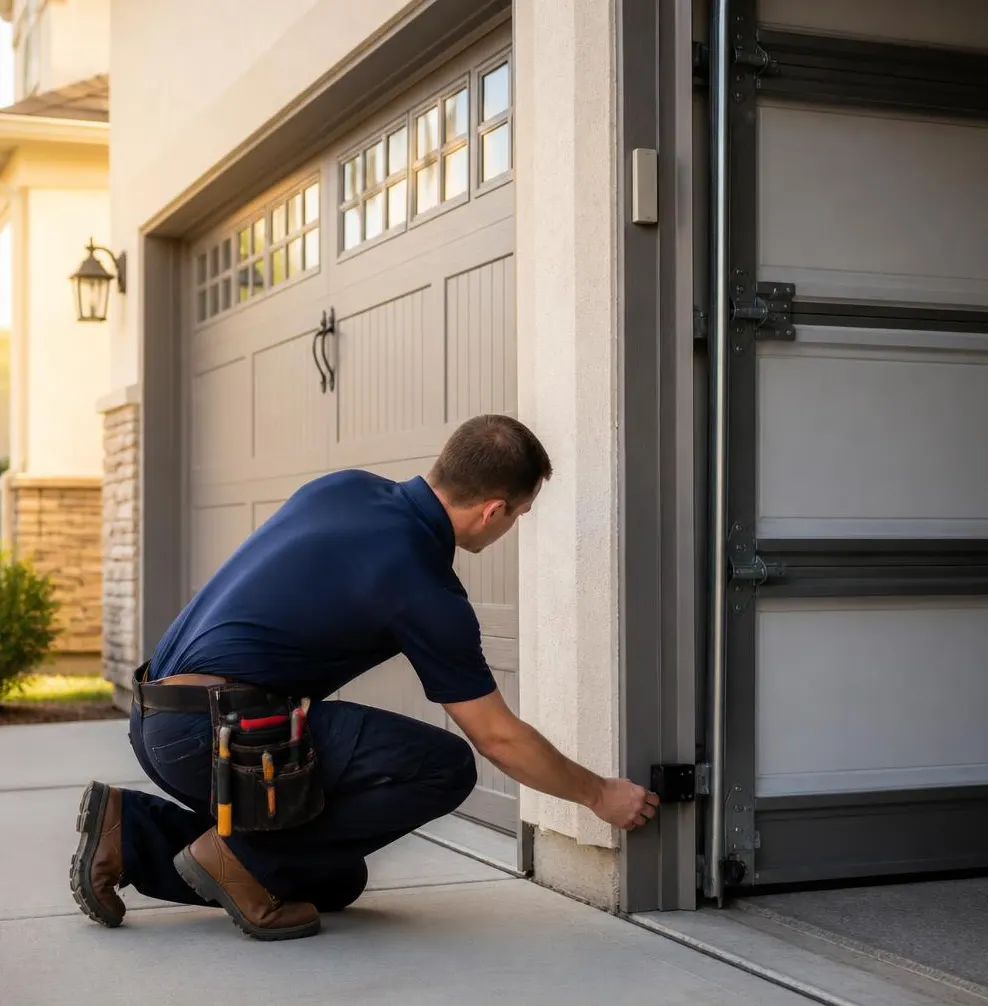
If your garage door starts closing and then reverses back up, or refuses to close at all, the most likely cause is the safety reversal system doing exactly what it's designed to do. Before you assume something expensive is wrong, check the photo-eye sensors near the bottom of the tracks — misalignment, dirt, or glare account for the majority of these calls. From there, a technician works down a short, predictable list.
What the Symptoms Tell You
Not all "won't close" problems look the same, and the pattern matters:
- Door reverses the instant it starts down: usually a sensor or wiring issue, since the opener is getting a stop signal almost immediately.
- Door closes most of the way, then reverses near the floor: often a sensor alignment issue, a bent track, or debris low in the track path.
- Door won't move at all when you try to close it: could be sensors, but also check for a blinking light on the opener — most units flash an error code that points to the cause.
- Door closes fine some days and not others: this pattern points toward sunlight angle hitting the sensors, temperature swings affecting wiring, or a spring that's getting weaker.
What a Technician Checks, In Order
1. Safety Sensors (Photo Eyes)
These small units sit a few inches off the floor on either side of the door and send an invisible beam across the opening. If anything blocks that beam — a storage bin, a bike, a pet, even a cobweb — the door will reverse or refuse to close. In fall and winter, low-angle sun can wash out the sensor's beam at certain times of day, and cold mornings can leave a film of condensation on the lenses. The fix is usually simple: wipe both lenses clean, check that the small indicator lights on each sensor are solid (not blinking), and make sure both units are aimed directly at each other. A sensor that's been bumped out of alignment, which happens easily with a broom or a car door, is a five-minute adjustment.
2. Sensor Wiring and Connections
If the lenses are clean and aligned but the light is still blinking, the wire running to the sensor may be nicked, pinched, or chewed through. This is common in garages where the wire runs along the floor near the track, where it's exposed to road salt tracked in off winter tires and the general wear of a garage floor. A damaged wire gets spliced or replaced, which is straightforward but worth having a professional confirm since a short can sometimes mimic a sensor failure.
3. Opener Force and Limit Settings
Every opener has settings that tell it how far to travel and how much resistance to tolerate before reversing. If these are set too sensitive, the door can trigger a false reversal on cold days when the metal contracts slightly or when the door feels heavier than usual. A technician recalibrates these settings rather than cranking up the force blindly, since overriding the force setting too far defeats the safety feature it's there for.
4. Tracks and Rollers
Ice buildup, dried mud tracked in during spring thaw, or a roller that's worked loose can all cause the door to bind partway down, which the opener reads as an obstruction. This gets checked by running the door manually (with the opener disconnected) to feel for rough spots, then cleaning, lubricating, or replacing rollers as needed.
5. Springs and Cables
If the door is heavy to lift by hand, a spring may be losing tension or close to failing. A weakened spring makes the opener work harder than it should, and the extra strain can trigger the safety reversal even with no obstruction present. Springs under tension are not a DIY repair — they store enough force to cause serious injury — so this is strictly a professional job involving spring replacement matched to the door's weight and size.
6. Opener Circuit Board
On older openers, a failing circuit board can send inconsistent signals that look like a sensor problem but aren't. This is usually the last thing checked, after the simpler and more common causes have been ruled out, because board replacement or a full opener swap is a bigger job.
When to Call Madison Overhead Door Co
If you've cleaned and realigned the sensors and the door still won't close reliably, or if the door feels heavy and you suspect a spring issue, it's time to call in a technician. Madison Overhead Door Co handles both garage door opener service and spring replacement, and we'll diagnose the actual cause rather than just reset the settings and hope it holds through the next cold snap.
If your garage door in Madison, Middleton, Fitchburg, or anywhere around Dane County is reversing before it closes, give us a call — we'll get it diagnosed and working right before the hard winter weather sets in.